Fiverr Vs Upwork Comparison: Which Is Better For Freelancers?
The freelance market is expected to grow exponentially in 2025. Remote work is no longer a trend; it’s a lifestyle. More professional traditional 9-5 jobs are leaving behind flexibility, freedom, and customers around the world. However, with numerous freelance platforms available, selecting the right one can be overwhelming. This is where the Fiverr vs. Upwork comparison begins.
Fiverr and Upwork are two of the largest names in the freelance industry. They provide unique ways to find both work, form a customer base, and increase their income, but they are not the same. Fiverr is extended to gig-based services, with freelancers setting up the prepared offer. Upwork focuses more on long-term contracts and custom project bids.
Whether you are a designer, writer, developer, or virtual assistant, understanding how these platforms work can help you secure better jobs and avoid general losses. In this guide, we will break down the significant differences in pricing, job types, payment systems, and freelancer support so you can decide on the platform that fits your goals. Let’s go in comparison to full Fiverr vs. Upwork and see which understanding for you in 2025.
Overview: Fiverr Vs Upwork Comparison
Fiverr focuses on freelancers who offer their services as a ready-to-buy package, making it easier for customers to browse and order immediately. However, Upwork stresses the project-based hiring, where customers review the proposals and select the best fit based on skills, experiences, and rates.
| Platform | Fiverr | Upwork |
|---|---|---|
| Structure | Gig-based | Project-based |
| How Work Begins | Clients find you | You apply for jobs |
| Ideal For | Short, fast tasks | Long-term projects |
| Fee Structure | Flat 20% | 20% → 10% → 5% tiered |
| Flexibility | Simple, set packages | Highly customizable |
Finally, there is no one size-fit-all answer. Think about your goals, work style and favorite communication approach. Do you want immediate gigs, or do you like to crafting proposals and make long -term partnerships? Whatever path you choose, stability, quality and professionalism will help you succeed. And if you are ambitious, you can use both platforms together which can give you both the best of the world.
Fiverr: A Marketplace Built for Quick Services
Fiverr is simple. You make “gigs” (eg, digital store), and customers come to you. This is great for freelancers who want to offer clear, fixed-value services. You do not need to chase customers: they browse and buy when ready. It works best for fast, one-time functions such as logo design, voiceover, or a quick coding fix. You determine your prices, package, and delivery time. Fiverr handles the transaction, so you can focus on your work.
What makes Fiverr stand out is easy to use. You can create a profile, list a service, and start earning – often within days. The platform does a good job of connecting buyers with freelancers, especially when your gig is adapted with the right title and tag. Reviews and ratings are created over time, which gives new vendors a chance to do quality work.
| Category | Details |
|---|---|
| Best For: | • Creatives (designers, voice-over artists, editors) • Side hustlers and beginners • Freelancers offering defined deliverables (e.g., “1 logo in 24 hours”) |
| Pros: | • Fast setup and low barrier to entry • No need to write proposals • Great for passive sales |
| Cons: | • 20% fee on all earnings • Competition is high in popular categories • Limited relationship-building with clients |
Fiverr is ideal for those who want to dive into freelancing without overcomplicating the process. This is particularly useful if you have a niche skill and can distribute it quickly and clearly. While the competition can be terrible, platforms rewards consistency, creativity and customer satisfaction. With strong views, smart gig titles and reliable delivery, even beginners can thrive. If you are looking for a straightforward way to convert your skills into income – without cold pitching hassle – is a great place to start the fiber.
Upwork: Ideal for Long-Term Freelance Careers
Upwork gives more control to freelancers, but with it comes more effort. Instead of waiting for customers to arrive, you actively discover jobs and submit a proposal. Customer posts the project details, and you pitch your skills, rates, and timelines. It creates a great fit for freelancers who want to give land to long-term or high-value work such as web development, content marketing, design, or business consulting.
What is different is that it is a chance to make ongoing relationships. Many customers return with repeat projects, helping you to build a stable stream of income. As you complete more jobs with strong reviews, your profile ranks higher, giving you even better opportunities.
Upwork is ideal if you enjoy customizing your offer, interacting with words, and managing projects at a deep level. It is like running a small freelance business-and is perfect for those ready to develop a serious, career-centric freelancing path.
| Category | Details |
|---|---|
| Best For: | • Developers, marketers, consultants • Full-time freelancers • Ongoing or large-scale projects |
| Pros: | • Scales well with experience • Escrow system ensures payment safety • Tools for hourly tracking, messaging, and video calls |
| Cons: | • You must write job proposals • High competition in entry-level jobs • 20% fee on the first $500 per client |
Upwork is designed for freelancers who want to treat their crafts like a long-term business. This can make more efforts with proposals, interviews, and customer follow-up-but it is worth paying it. The platform is ideal for building strong customer relationships, landing recurring projects, and increasing its freelance income over time. As your reputation increases, your opportunities grow. If you are ready to invest in your freelance career and make something durable, Upwork gives you the equipment and freedom to do so.
User Experience Fiverr Vs Upwork Comparison
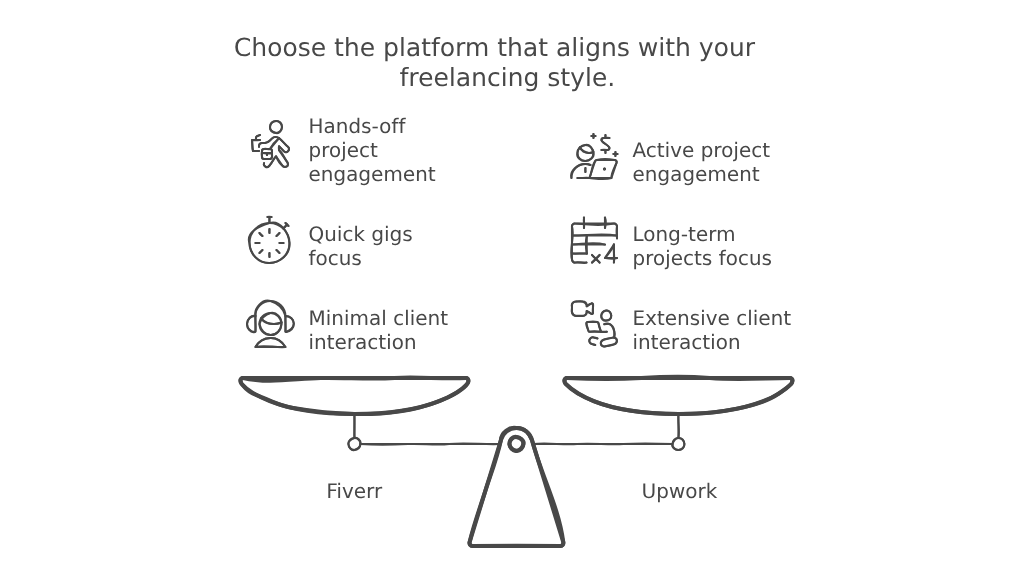
Working on the Fiverr Vs Upwork Comparison feels very different day to day. Fiverr is more hands-off—you post your service and wait for buyers. It’s fast and simple, great for quick gigs. Upwork, on the other hand, involves more back-and-forth. You apply to jobs, chat with clients, and often work on longer-term projects. One feels like a storefront, the other like a freelance office.
Fiverr: –
Fiverr is designed for freelancers who want to keep things simple. You do not need to pursue customers or pitch yourself constantly. Instead, you set your services as “gigs”, list your prices, and let the platforms work to bring customers to you. This is perfect for creative, developers, and service providers who want to focus more on delivery than interaction.
- Set-the-and-Fargate-It Style clients browse and buy.
- There is no need for proposals or interviews.
- Most communication occurs after purchases.
- You handle everything in the realm of your gig.
- Positive reviews help promote visibility and future sales.
Fiverr is great for those who enjoy clear boundaries, rapid book projects, and minimum back-end work. This is particularly useful if you have repeated services and want to create a stable flow of income without the problem of hunting. If you give importance to speed, automation, and a market that works for you in the background, Fiverr saves.
Upwork: –
Upwork gives more control to freelancers, but also has more responsibility. Unlike Fiverr, you do not list services and wait. Instead, you actively apply for jobs by sending proposals. This platform is ideal for those who are looking at large, ongoing projects and creating long-term customer relationships.
- Proposal writing and customer service are part of the interview process.
- You pitch your value before winning the project.
- Customers often expect cooperation, updates, and meetings.
- Projects are broken into clear contracts and milestones.
- You can interact with conditions, deadlines, and rates.
If you work closely with customers, build trust, and take on complex or long-term projects, then Upwork is a great fit. It sounds like a freelance agency model – Great for those who treat freelancing as a serious career path. With effort and stability, the upwork can become a strong foundation for durable, high-value freelance work.
Payment & Fees: What You Actually Take Home
Let’s talk money. While both Fiverr Vs Upwork Comparison offer solid opportunities to earn, the way they handle fees is very different. Fiverr is flat and simple, while Upwork uses a sliding scale that benefits long-term client relationships. What you keep in your pocket can vary depending on how you work.
Fiverr: –
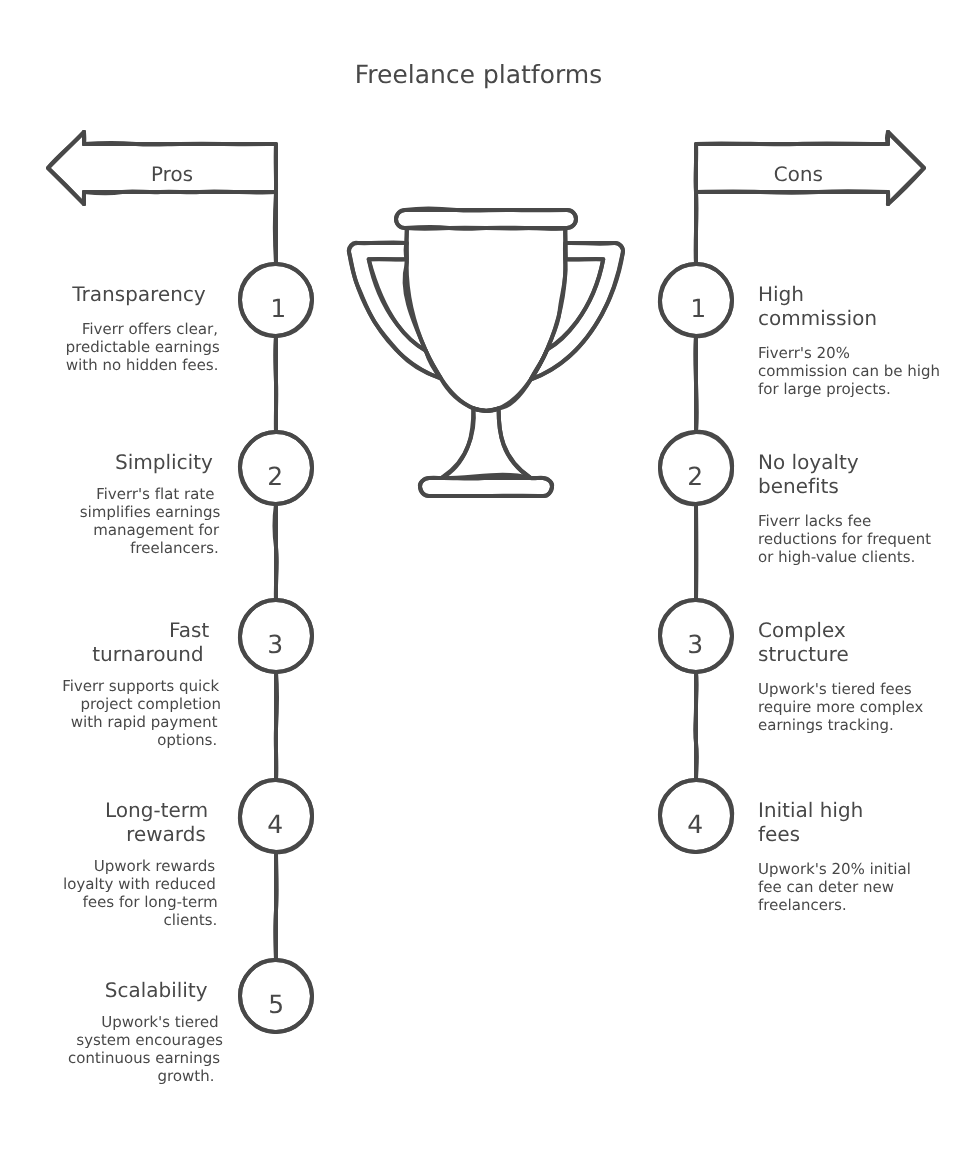
One of the biggest benefits of Fiverr is its transparency. There are no hidden rules or complex pricing structures. Each freelancer, whether completely new or highly experienced, replaces the same model. This makes it easier to predict your earnings and plan your workload without complex mathematics. You do not have to worry about slipping the scales or completing the specific threshold to unlock better rates. What you see is what you get.
- Flat 20% commission on all orders, regardless of size
- No low fees for frequent or high-trigrants
- Funds are issued 14 days after the order is completed
- Top-rated sellers can qualify for a rapid return time
- Short, ideal for one-time projects or passive service offerings
- Simple, consistent, and beginner
The fee structure of Fiverr may not be the cheapest, but it is clear, approximate, and easy to manage. For freelancers who prefer simplicity and do not want to stress about the tracking of proposal cycles or milestones, this is a proper business. You focus on your craft – Fiverr takes care of the rest. If you are offering fast turnaround services, this fee model supports a smooth and stable workflow.
Upwork: –
Upwork takes a more dynamic approach to freelancer fees. Instead of a flat rate, it uses a progressive system that rewards long-term customer relationships. The more you earn from a customer, the lower the upwork, which also increases loyalty and ongoing work. This structure benefits freelancers focusing on high-value or recurring projects, making it easier to increase earnings over time.
- 20% fee on the first $ 500 earned from a customer
- 10% on earnings between $ 500- $ 10,000
- 5% fee on anything more than $ 10,000 with the same customer
- As soon as you make working history, the fee falls automatically
- Withdrawal is quickly available based on the method
- Customized for retainers, long-term contracts,a nd repeat customers
- Designed to reward commitment and strong customer relations
The Upwork tier fee structure is designed for freelancers who want to scale continuously. This is the advocate of those who can distribute the price over time and maintain the client’s trust. When you start at 20%, the ability to reduce fees with each milestone makes an attractive platform for serious professionals, which aims to change freelancing in a long-term career.
How to Get Clients: Fiverr Vs Upwork Comparison
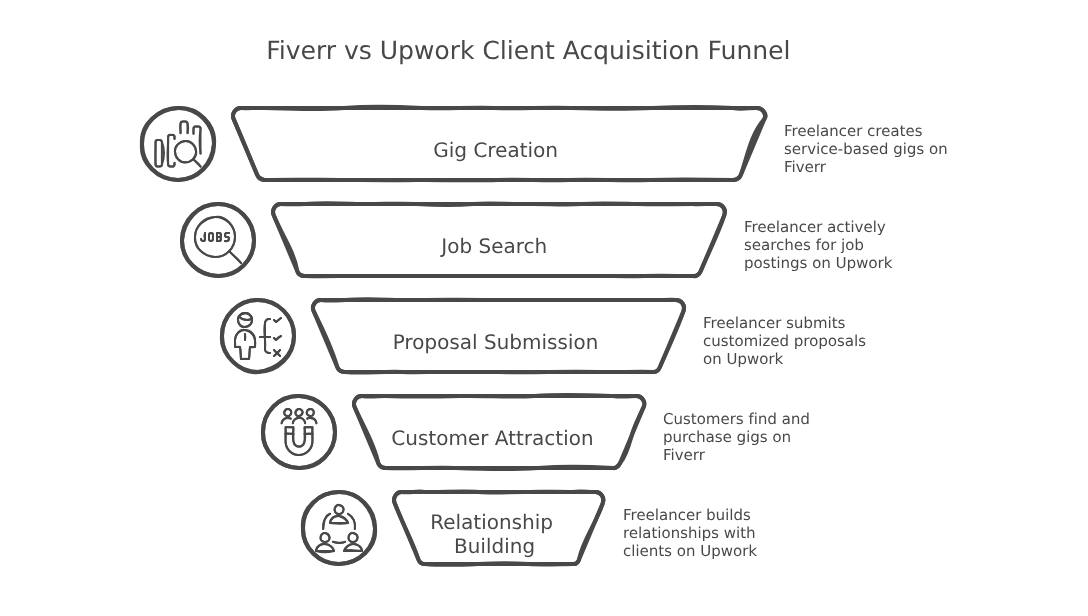
How you get customers on Fiverr Vs Upwork Comparison depends on your working style. On Fiverr, the process is mostly inactive-you make service-based gigs, adapt them to search, and wait for customers to find. Your gig of image, title, details, and reviews plays a big role in attracting attention. If you rank well in the algorithm of Fiverr, the customers will come to you without much additional effort. On the other hand, Upwork is a more active platform. You have to search for jobs, write a custom offer, and each customer will have to sell itself directly. It gives you more control, but also requires more time and strategy. If you enjoy pitching, interacting, and building long-term relationships, Upwork may be a better fit.
Fiverr: –
Fiverr acts like a digital storefront. You make gigs (services), and customers browse them like shopping on Amazon. Your job is to make your offerings attractive, clear, and easy to buy. You do not lead the chase – your success depends on how well you present yourself.
- Customers browse and buy gigs like products
- Your gig of image, title, tag, and SEO tis he most
- No need to apply – Buyers come to you
- Fiverr’s algorithm decides how much your gigs appear
- Best pack for freelancers, offering repeated services
If you want to focus more on serving your service than your marketing, then Fiverr is a great option. Once your gigs are customized and live, they can sell at any time – even when you sleep. It is particularly useful for freelancers who want to create a passive income stream through well-defined offerings.
Upwork: –
Upwork puts you in the driver’s seat. Instead of waiting for customers to find you, you actively search for job postings and send customized offers. This approach to the hands gives you more control over whom you work with and how you shape your freelance career.
- You browse the job listing and submit a proposal
- You decide who to pitch, what the price is, and what to include
- Need more effort, but gives more control
- Ideal for freelancers enjoying direct customer communication
- Perfect for custom projects, retainer,s and long-term work
Upwork is best suited for freelancers who want to take charge of their business. This rewards people who can write a compelling proposal, interact well, and permanent customers can build relationships. If you are comfortable with outreach and enjoy crafting your offer, Upwork gives you the freedom to grow on your terms.
Which Platform Helps You Grow?
Growth looks different on Fiverr and Upwork. Both platforms reward quality work, but they offer different paths. Fiverr helps you scale through better gig optimization, while Upwork opens doors to long-term clients and higher-value contracts. Here’s how to grow on each platform.
Fiverr Growth Tips: –
Fiverr is about presentation, review, and reliability. The better your gig looks, the happier you are, the faster your profile grows. It is a market that rewards those who focus on continuity and expansion.
- Use all three gig packages (basic/standard/premium) for UPSELL services
- Always distribute on time and target 5-star reviews
- Add FAQs, Gig Extra, and Video Previews to promote conversions
- Be active on stage to maintain or improve your gig rankings
- If you have verified credentials or proven expertise, apply for Fiverr Pro
Success on Fiverr is not caused by accident – it is created through belief, clarity, and distribution. By adapting your gigs and treating each order professionally, you keep yourself in a position for long-term development and stable income. A polished profile with great reviews is your strongest sales tool.
Upwork Growth Tips: –
Upwork rewards freelancers who continuously provide quality and build a permanent relationship with customers. The key to success is smart outreach, professionalism, and ongoing improvement. It is less about attractive profiles and more about results and reliability.
- Keep proposals relevant to small, individual, and straightforward customer needs
- Focus on maintaining customers to benefit from the sliding fee structure of Upwork
- Maintain a high job success score (JSS) by completing the job on time and exceeding expectations
- Apply for Upwork talent badges like Rising Talent or Top Rated to achieve visibility
- If you want to scale or cooperate with a team, consider creating an agency profile
The growth on Upwork comes from stability and relationship-making. Each successful project creates your reputation, opens doors for large opportunities, and reduces platform fees over time. If you consider each customer like a long-term partner, Upwork will reward you with better ranking, more inviting, and permanent freelance income.
Both platforms reward consistency, clear communication, and professionalism. But if you’re aiming to grow into an agency or build a full-time freelance career, Upwork gives you more tools, more flexibility, and more room to scale. Fiverr is ideal for quick wins and productized services, especially if you’re just starting. Upwork is better for building deep client relationships and securing long-term contracts.
Fiverr Vs Upwork Comparison Table:
| Feature | Fiverr | Upwork |
|---|---|---|
| Client Interaction | Passive – clients find and order gigs | Active – you apply to jobs |
| Best For | Quick, defined services | Long-term, custom projects |
| Fee Structure | Flat 20% on all gigs | 20% → 10% → 5% per client |
| Growth Path | Optimize gigs and reviews | Client retention and badges |
| Flexibility | Less—gig structure is fixed | More—custom offers and contracts |
Which Platform Is Better for Beginners?
If you are starting now, Fiverr can be easy to break. You do not need to pitch, write cover letters or manage hourly contracts per hour. Setting a gig is quick, and the platform outreach for you. But keep in mind – the competition is fierce, and standing out is an effort through customized listing and solid reviews.
On the other hand, at Upwork, your first job may take longer to complete. You will need to prepare individual proposals and compete with experienced freelancers. However, once you create some strong customer relationships, the ability to increase and charge high rates may come faster. This is a slow start, but often a more scalable path.
Discover tools, tips, and platform guides to kickstart your journey in Freelance & Remote work. From flexible gigs to long-term projects, we help you succeed anywhere you choose to work.
FAQs: About Fiverr Vs Upwork Comparison
1. Which platform pays freelancers more in the long run?
Upwork generally offers higher income potential if you build long-term client relationships.
2. Can I create accounts on both Fiverr and Upwork?
Yes. Many freelancers use both to diversify and reach more clients.
3. Which is faster to start earning on?
Fiverr is typically quicker because you don’t need to apply for jobs—clients find your gig.
4. Do either platform require interviews?
Fiverr usually doesn’t. Upwork often includes client interviews or chats before hiring.
5. What’s the biggest difference between Fiverr and Upwork?
Fiverr is gig-based (clients buy), while Upwork is proposal-based (you apply for jobs).