

It can be exhilarating to become a new gig worker. You can have flexible schedules, play around with different gig sites, and earn through the gig economy. However, your first few weeks of working can also be overwhelming. Beginners tend to only concentrate on securing new gigs. Gig worker mistakes often reduce your profit.
Costs, timing, taxes, platform policies, and many others are things beginners fail to consider in their eagerness to get new gigs. This tends to cost new gig workers much. Fortunately, most of these beginner mistakes can be easily corrected when one becomes familiar with them.
In this guide, seven of the commonest mistakes that beginners in gig work commit and ways to overcome them will be discussed.
Quick Answer: What Are the Biggest Mistakes New Gig Workers Make?
The most common mistakes are:
- Focusing only on gross earnings
- Accepting every job or order
- Ignoring mileage and expenses
- Working without a schedule
- Depending on one platform
- Forgetting taxes and records
- Ignoring customer service and ratings
The biggest lesson is simple. Gig work should be treated like a small business.
You need to track income, control costs, protect your time, and make decisions based on profit.
Mistake 1: Focusing Only on Gross Earnings

This is one of the biggest mistakes beginners make. Gig worker mistakes can waste valuable time.
You open the app and see $150 in earnings. It feels like you made $150.
But that is not always your real profit.
You may still have to pay for:
- Fuel
- Parking
- Vehicle maintenance
- Phone service
- Insurance
- Platform fees
- Equipment
- Taxes
Other work related costs
For example, imagine you earn $150 in one day.
You spend $20 on fuel and $10 on parking.
Your earnings are already down to $120 before other costs.
If you also add vehicle wear and taxes, your real profit may be lower.
How to Avoid This Mistake
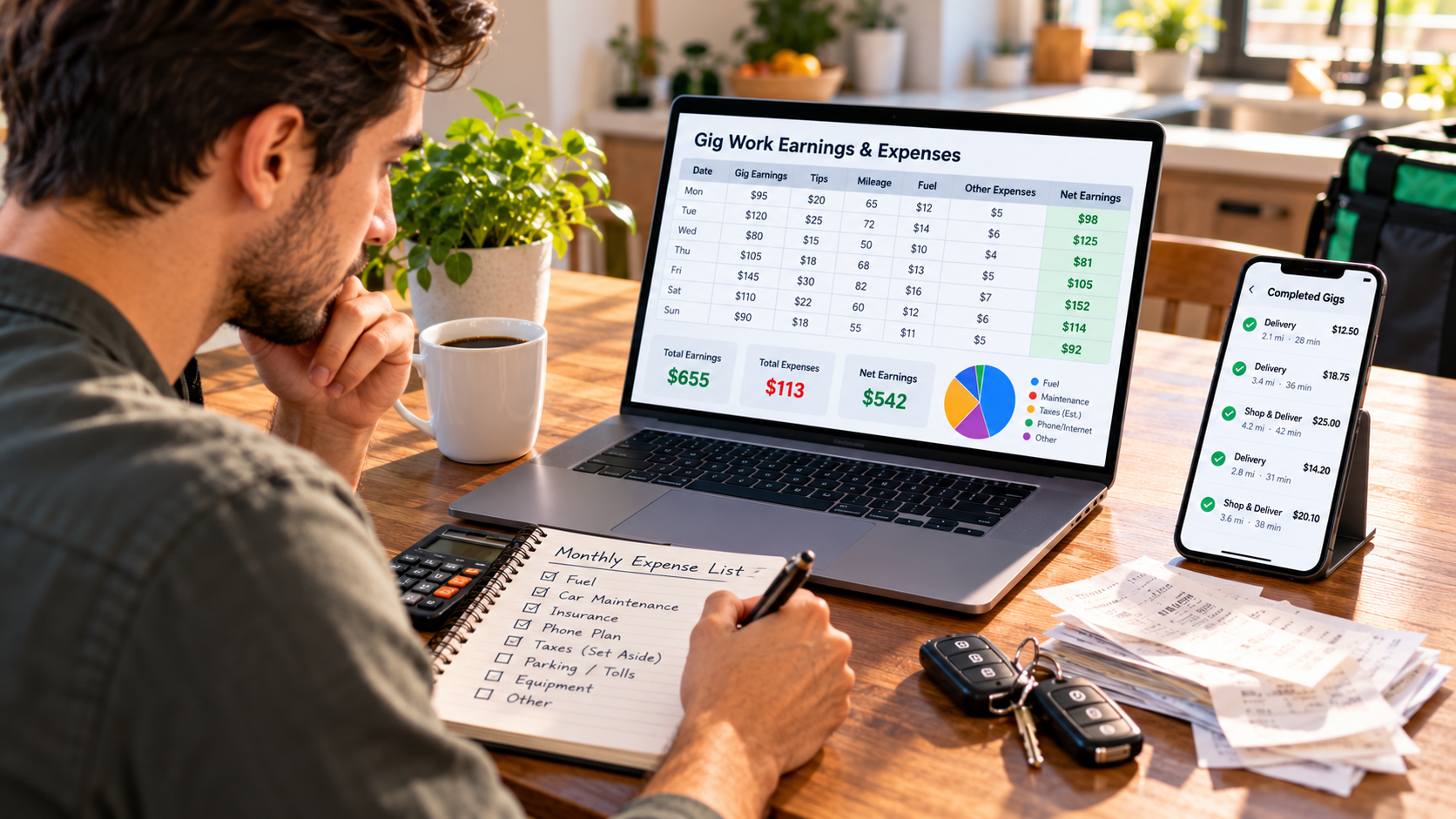
Track both income and expenses.
You can use a spreadsheet, notebook, or budgeting app.
Record:
- Gross earnings
- Tips
- Hours worked
- Mileage
- Fuel
- Parking
- Tolls
Other expenses
At the end of the week, calculate what you actually kept.
That number matters more than the earnings shown in the app.
Mistake 2: Accepting Every Job or Order
New gig workers often think they need to accept everything.
They worry that rejecting work means losing money.
But not every offer is worth your time.
A delivery may pay $12, but it could take 45 minutes and require a long drive.
Another offer may pay $9 but take only 20 minutes.
The second job may actually be better. Gig worker mistakes may increase work expenses.
The same idea applies to freelance work.
A client may offer $50 for a project that takes eight hours. Another client may offer $40 for a project that takes two hours.
Higher pay does not always mean better profit.
How to Avoid This Mistake
Look at the full job before accepting.
For delivery gigs, check:
Distance
Time
- Traffic
- Pickup location
- Pay
- Tips
- Parking
- Return distance
For freelance gigs, check:
Project scope
Deadline
Number of revisions
Client requirements
Estimated hours
Payment
Ask yourself one simple question:
Is this job worth the time and cost?
That question can save you from many bad offers.
Mistake 3: Ignoring Mileage and Vehicle Costs
This mistake is common among drivers and delivery workers. Gig worker mistakes can hurt customer ratings.
A car makes gig work easier, but every mile has a cost.
You are not only paying for gas.
Driving also creates:
- Tire wear
- Oil changes
- Brake wear
- Repairs
- Depreciation
Insurance costs
More frequent servicing
A gig may look profitable until you calculate how much driving it requires.
For example, earning $100 while driving 150 miles is very different from earning $100 while driving 50 miles.
The second day may leave you with much more real profit.
How to Avoid This Mistake
Track your mileage every day.
Write down:
- Starting mileage
- Ending mileage
- Business miles
- Personal miles
You can also use a mileage tracking app.
Then compare your total miles with your total earnings.
Try to reduce empty driving.
Stay near busy areas when possible. Avoid driving long distances without an active job.
For delivery work, learn which stores and neighborhoods give you the best results.
Mistake 4: Working Without a Schedule
Gig work is flexible, but too much flexibility can become a problem. Gig worker mistakes often cause unnecessary stress.
Some beginners go online whenever they feel like it. They may work during slow hours and stop during busy periods.
Others stay online all day because they are afraid of missing opportunities.
Both approaches can waste time.
A flexible schedule still needs structure.
How to Avoid This Mistake
Create a simple weekly plan.
For example:
Monday: 5 PM to 9 PM
Wednesday: 11 AM to 2 PM
Friday: 5 PM to 10 PM
Saturday: 10 AM to 4 PM
Your best schedule depends on the type of gig.
Delivery apps may be busier around lunch and dinner.
Rideshare work may be stronger during commuting hours or weekend evenings.
Freelance work may be easier when you block several quiet hours for focused work.
Track your earnings by time. Gig worker mistakes become easier to avoid.
After a few weeks, you may notice certain hours are much more profitable.
Focus on those periods.
Mistake 5: Depending on One Platform
Using one platform is simple.
But relying on only one source of income can be risky.
Gig platforms can change:
- Pay structures
- Fees
- Algorithms
- Demand
- Account rules
- Bonuses
Eligibility requirements
Your account could also be temporarily limited or reviewed.
If all your income comes from one app, a small change can create a big problem.
How to Avoid This Mistake
Do not sign up for ten apps at once.
Start with one platform and learn how it works.
Once you understand it, consider adding another option.
For example, a delivery worker might use two different delivery apps.
A freelancer might use a marketplace plus direct clients.
A driver might combine rideshare and delivery work.
The goal is not to manage too many apps.
The goal is to avoid having only one income source.
Mistake 6: Forgetting Taxes and Financial Records
Gig workers are often independent contractors.
That usually means taxes are not handled in the same way as a normal employee paycheck.
New workers may spend all their income and forget that part of it may need to be saved for taxes.
This can create a problem later.
Poor records can also make tax preparation more difficult.
How to Avoid This Mistake
Keep your work finances organized from the beginning.
Business related subscriptions
Keep receipts when needed.
You may also want a separate bank account for gig income and expenses.
This can make tracking easier.
Tax rules depend on your location and personal situation.
If you are unsure, speak with a qualified tax professional.
The important point is to plan early.
Do not wait until tax season to organize everything.
Mistake 7: Ignoring Customer Service and Ratings
Gig work may feel independent, but customers still matter.
Poor communication can hurt your ratings.
Low ratings can reduce trust and may affect access to future opportunities on some platforms.
For delivery workers, common problems include:
Ignoring delivery instructions
Leaving orders at the wrong location
Poor communication
Damaged items
Late delivery
For freelancers, common problems include:
Missing deadlines
Poor updates
Unclear communication
Ignoring revisions
Delivering incomplete work
Good service does not mean saying yes to every request.
It means being reliable and professional.
How to Avoid This Mistake
Read instructions carefully.
Communicate when needed.
Deliver what you promised.
Do not make promises you cannot keep.
If there is a problem, explain it clearly.
For example, if a restaurant is delayed, a short message can help.
If a freelance project needs more time, tell the client before the deadline.
Small communication habits can protect your reputation.
Bonus Mistake: Chasing Bonuses Without Checking the Real Value
Many gig platforms offer promotions or bonuses.
These can be useful.
But they can also push workers to take bad jobs.
For example, a platform may offer a bonus after completing a certain number of deliveries.
You may start accepting low value orders just to reach the target.
That can increase mileage and reduce profit.
How to Avoid This Mistake
Calculate the full value before chasing a bonus.
Ask:
How many jobs do I need?
How many extra hours will it take?
How much driving is involved?
Will I accept lower quality work?
Does the bonus still make sense after expenses?
A promotion should improve your income.
It should not make you work harder for less profit.
How to Avoid This Mistake
Set a daily limit.
For example:
Maximum 6 hours
Maximum 8 deliveries
Stop after a certain earnings target
Take a break every few hours
Your exact limit depends on the job.
The goal is to stay productive without exhausting yourself.
How to Build a Better Gig Work Routine
A good routine improves your daily gig work. It helps reduce common beginner mistakes. It also keeps your work more organized.
Start every day with a clear plan. Decide when you want to work. Choose the area you will cover. Set a realistic daily earnings target. Also decide your maximum working hours. Gig worker mistakes can limit long-term growth.
Your plan should include basic expense limits. This can include fuel and parking. It may also include toll costs. Small expenses can reduce your real profit.
Track your results throughout the working day. Record each job you complete. Write down how much you earned. Also track your work related expenses.
At day’s end, review your results. Check whether you reached your target. Compare your earnings with your expenses. Also check your total working hours.

A Simple Gig Worker Weekly Tracker
You can use a table like this:
| Day | Hours | Gross Earnings | Expenses | Net Earnings |
|---|---|---|---|---|
| Monday | 4 | $85 | $15 | $70 |
| Tuesday | 3 | $62 | $10 | $52 |
| Wednesday | 5 | $105 | $18 | $87 |
| Thursday | 0 | $0 | $0 | $0 |
| Friday | 5 | $120 | $20 | $100 |
| Saturday | 6 | $145 | $25 | $120 |
| Sunday | 3 | $70 | $12 | $58 |
This helps you see which days are worth your time.
You may discover that Saturday performs much better than Tuesday.
Then you can adjust your schedule.
How to Know If a Gig Is Worth It
Do not ask only:
How much did I earn?
Also ask:
How long did it take?
What did it cost?
How stressful was it?
How many miles did I drive?
Did it help my long term goals?
A gig that pays $25 per hour gross may not be better than one that pays $20 per hour if the first option has much higher expenses.
Always look at the full picture.
Frequently Asked Questions
What Is the Biggest Mistake New Gig Workers Make?
One of the biggest mistakes is focusing only on gross earnings.
Your real profit is what remains after expenses.
Should I Accept Every Gig Job?
No.
Review the pay, time, distance, and effort before accepting.
Some jobs are not worth the cost.
How Many Gig Apps Should I Use?
Start with one.
Once you understand it, you can add another platform if it makes sense.
Using too many apps too early can become confusing.
Should Gig Workers Track Mileage?
Yes.
Mileage can help you understand vehicle costs and business activity.
It may also be useful for financial records.
Do Gig Workers Need to Save for Taxes?
In many cases, yes.
Tax rules depend on your country and work status.
It is smart to plan ahead and keep good records.
Is It Bad to Reject Low Paying Gigs?
Not necessarily.
The goal is to choose work that makes financial sense.
A low paying job can cost more time and money than it is worth.
How Can I Improve My Gig Worker Rating?
Follow instructions, communicate clearly, deliver on time, and provide consistent service.
Small habits can make a big difference.
Is Gig Work Good for Beginners?
Yes, it can be.
Gig work can offer flexible income and useful experience.
But beginners should track costs and learn how each platform works.
Can Gig Work Become Full Time Income?
For some people, yes.
It depends on demand, skill, location, hours, expenses, and the type of work.
Income is not guaranteed.